I am more of a physics hobbyist than a professional.
I wonder to what degree you all are open to challenging the isotropic assumption of relativity theory?
I have some fundamental mathematics called polysign
http://bandtech.com/PolySigned/index.html
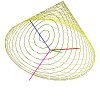
which yields some interesting graphics such as

This iterated graphic contains no conditionals as would a Mandelbrot type of function. This data is largely disklike, though I still have not characterized it well. This is a five dimensional projection, but the operation works in any dimension.
Polysign produces arithmetic support for spacetime with unidirectional time, which is to say that it is a candidate for an emergent spacetime type of physical theory.
Electromagnetics is often regarded as a unified theory, yet we still to this day rely upon electricity and magnetism as informationally orthogonal concepts, even while the raw electron is accepted to contain a magnetic moment. For me, through polysign, the correct answer is to consider structured spacetime, in the form of the tatrix, and the next step is to declare electromagnetic features within this math. How much more to ask for is an open problem.
The principles of polysign ask that we stop considering the real number as fundamental, and that instead the real number carries the structure
s x
where s is sign and x is magnitude. These are two more fundamental concepts, the sign being modulo behaved and generalizable, the magnitude being fundamental, as distance is. I am happy to answer any questions about it, and am especially interested in the high dimensional speculative theories that the LHC results may bolster. How will the LHC break out of the spacetime prison we are in to expose these features?
As I post this I see numerous little faces quaking at me to the left, and hope that I will find a way to make them disappear. Otherwise, I say bravo to your amazing interface and have viewed many of the pages monitoring the system. You are truely amazing people and are building a new culture. Your openness is applauded, at least here. That said I do study the skeptical worries and can't help but admit my own. Still, I will try to follow and learn from the LHC group.
- Tim


