At the forum we are working to put together all the info we can into a understandable form.
As we work on this I have decided to put up the inforamtion we think we know so far. These are very much best guesses
This is progressing daily. If you see a error or want to contribute go to the forum thread here
The displays
Other useful links / info
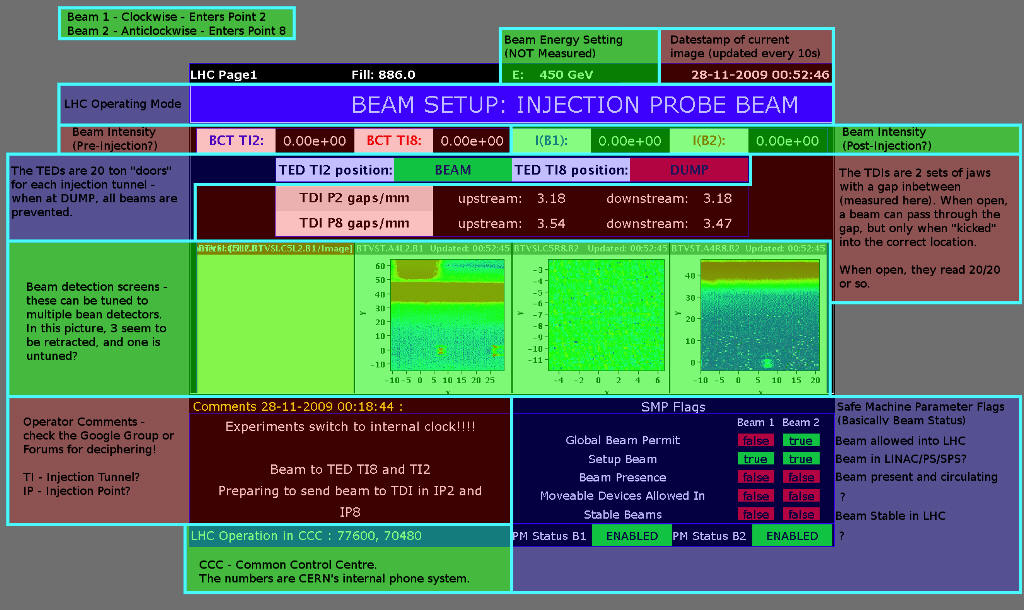
Our current best guess at Page 1
Page 1 is dynamically configured depending on the mode of the machine so the information available will vary.
Here are a few definitions to be going along with:
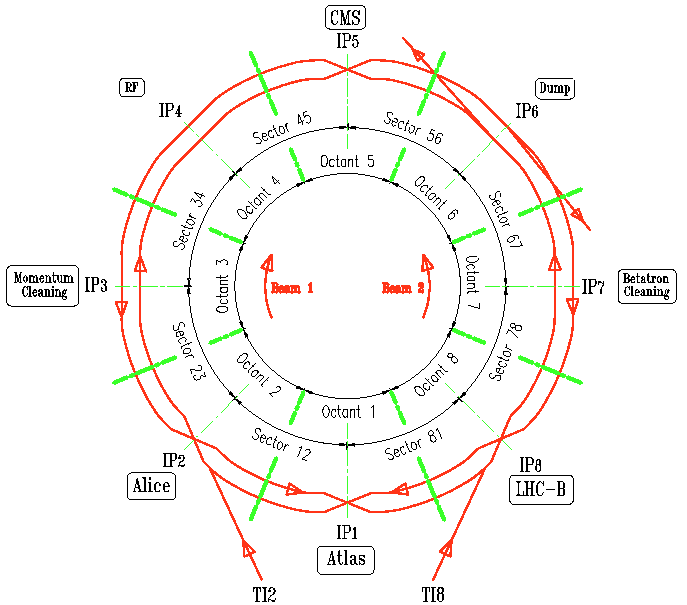
TI 2 - is the transfer line between the SPS and the LHC for the clockwise beam.
It is 2943m long.
TI 8 - is the anticlockwise transfer line from the SPS to LHCand is 2694m long
TED - stands for 'Target Extraction Dump' There are stoppers that can be put
into the transfer lines there is one at the top and one at the bottom of each
line (upstram and downstream) . Each one weighs about 20 tonnes.
TDI - this is an injection protection element just downstream of the injection
point. It has upper and lower jaws that can be moved into the beamline. If the
injection kickers fire correctly the beam will be fired through the gap between
the jaws. If the kickers do not fire - for example when we are setting up
injection - the beam hits one of the jaws and is absorbed.
BKG1,2,3 - These are figures of merit provided by the experiments to the
machine. Each one is derived from a specific part of the detector (and are
therefore experiment specific). They are normalized to a number between 1 (good)
and 5 (bad) - 0 means it is not yet active.
The SMP flags on the bottom right of the Page 1
SMP means "Safe Machine Parameters". EDMS 883620 lists (in a very roundabout way) the conditions under which each is true (except for Global Beam Permit, I guess that's a human decision). EDMS 810607 contains them too, along with other info (such as the locations of the detectors).
This site explains the codes above the four images on
LHC Page1. They denote the beam TV camera the image is coming from.
http://ab-dep-bi-pm.web.cern.ch/ab-dep- ... ies.BTVLHC
General LHC operation
During "regular physics
running" (which is still weeks-months away), the LHC mode of operations will be
done in "cycles".
Each cycle consists of several steps. First, the magnets are brought to currents
needed for injection energy beam (450 GeV per beam, which is what the maixum SPS
energy is). Then the beam is actually injected from the SPS until the LHC ring
is full. The next step is then the "ramp", i.e. the beams are accelerated. Once
the energy is reached (2.2 TeV around christmas, then 3.5 TeV next year,
eventually 5 TeV and 7 TeV in a few years after some major improvements), the
beams are kept at that energy (flat top) for a few hours and squeezed (i.e.
compressed to be as thin as possible) so that the collisions at the experiments
lead to a best-possible collision rate (luminosity). Once the beams are
depleted, the remains are dumped and the current in the magnet ramped down
(snapback). Then the whole story restarts from the beginning.
The LHC state that is shown on page 1 is the mode that the LHC is currently in,
i.e. which "master program" is controlling the components. There are a few of
them, some having a lot of automatism (which is for the future when the LHC will
mostly run autonomously), but also some needed for testing, where manual
adjustments are allowed by the operators.
The "pre-cycling" stage would be a stage where basically the LHC system is
ready, but none of the magnets are operating, i.e. the state before the start of
a new cycle (sort of "standby"). The next strage would then be "injection" or
"fill".
Everything below is fairly random right now. We are working on it.
Technical specifications for the LHC
https://edms.cern.ch/nav/LHCPM001/
Layout